Coverage by the work, not the logo
The catalogue is organised by what you are actually doing, and proved one workflow at a time. Below is what is a focus today and what is a plan, labelled so you are never guessing.
| Ref. | Category | Scope | Standing |
|---|---|---|---|
| W-01 | Architecture, engineering and construction | Coordination, design, review, rendering, analysis | First focus |
| W-02 | Digital media and creative production | Content creation, editorial, review | Intended |
| W-03 | Research and higher education | Analysis, simulation, visualisation, teaching | Intended |
| W-04 | Radiology and medical imaging | Research visualisation only | Intended |
1. Architecture, engineering and construction
AEC teams carry some of the heaviest desktop work anywhere, and some of the most spread-out review. Heavy models, distributed people. That is the problem Laridae is built for, so it is where we prove it first.
| Ref. | Workflow | What it means here |
|---|---|---|
| A1 | BIM coordination | Multi-discipline models coordinated in one environment instead of copies bouncing between machines. |
| A2 | Architectural design | Daily design in the tools your practice already runs, from a project environment that stays put. |
| A3 | Model review | Reviewers open the live model from ordinary hardware, with no workstation needed to look at heavy work. |
| A4 | Rendering and visualisation | Render and playback passes on remote capacity, on demand, without tying up a desk for hours. |
| A5 | Structural analysis | Analysis runs sized to the model, in short sessions that exist just for the task. |
| A6 | Environmental simulation | Daylight, energy, and airflow work on capacity that appears when you ask for it. |
| A7 | Distributed review | Site offices, consultants, and clients working against one environment inside one access boundary. |
2. Digital media and creative production
Creative work runs hot then cold. A quiet week, then a delivery crunch that wants every core it can find. A persistent project environment plus on-demand burst sessions is shaped for that curve.
We are aiming at content creation, editorial, and review, where the feel of the tool matters and the files are big enough that moving them is its own headache.
- 3D content and lookdev in a persistent environment
- Render passes as on-demand burst sessions
- Review and sign-off from ordinary devices
- Large project files that stay in one place
3. Research and higher education
Research groups and departments know the bind. The software is demanding, the hardware budget arrives in bursts, and the people who need the tools turn over every term.
We are aiming at analysis, simulation, and visualisation environments you can hand out per lab, per course, or per project, and reach from whatever hardware students and researchers already carry.1
What the work looks like
- Simulation and analysis on sized environments
- Visualisation of large datasets without local graphics hardware
- Course environments that reset cleanly between terms
- Shared project spaces with defined access
4. Radiology and medical imaging
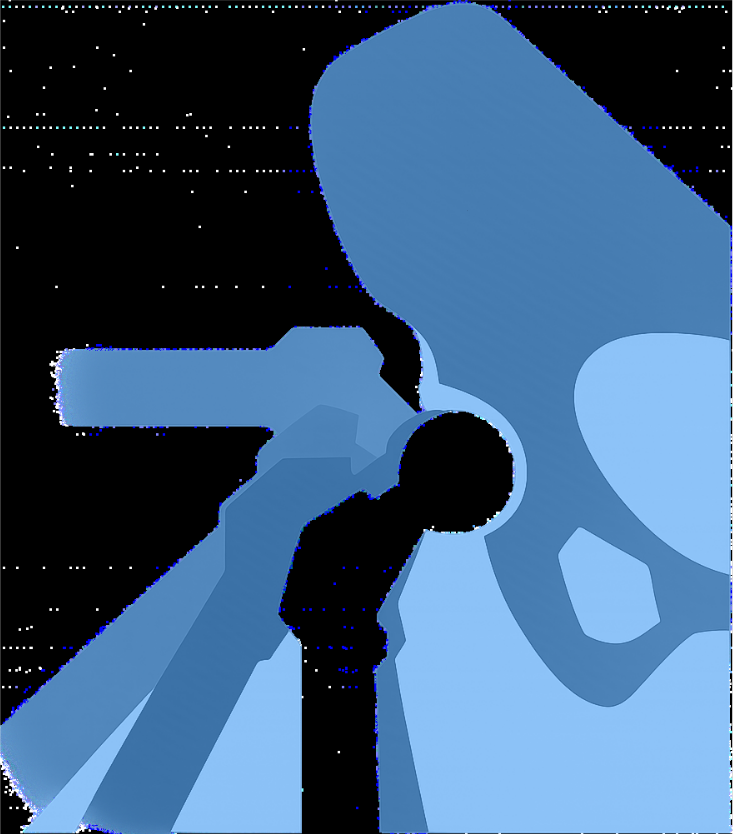
Imaging research works with some of the largest interactive datasets in professional computing. We are aiming at research visualisation, meaning exploring, rendering, and reviewing imaging data in environments built to hold it.
This is scoped to research. Laridae is not a diagnostic tool, and regulated data has a hard line, stated here.
Not for diagnostic use. Do not upload confidential, sensitive, medical, regulated, or client-restricted data unless it is separately approved in writing, with the right controls in place.
5. How software gets in
We build the catalogue workflow first. Validate the work, then the applications it depends on, going through licensing, compatibility, and support with the teams who actually use them.
That is slower than printing a logo wall and more honest. What an application can do here depends on its licensing, its compatibility, and its support, and we would rather tell you that up front than in the fine print.
How it goes
A team names a workflow
We map applications and licensing
We validate behaviour, input, and feel
It joins that team's catalogue
†This page describes the workflows we are building toward and validating rather than a list of supported products. Specific software availability, licensing, compatibility, and support have to be confirmed. Naming a workflow does not imply any application is licensed, validated, or vendor-approved.
1.Reaching a session from any device is the goal rather than a guarantee. Your actual experience depends on the device, browser, operating system, network, and the application's own requirements.